
Home › Mobility › Transfers and daily mobility
Transfers and daily mobility: moving safely through your day
Standing up from a chair, getting out of bed, using the toilet, getting into the car — we do these things dozens of times a day. Doing them safely, with the right technique and setup, protects your independence and helps prevent falls.
Written by Abhiraj Radhakrishnan, PT, MPT · 11-minute read
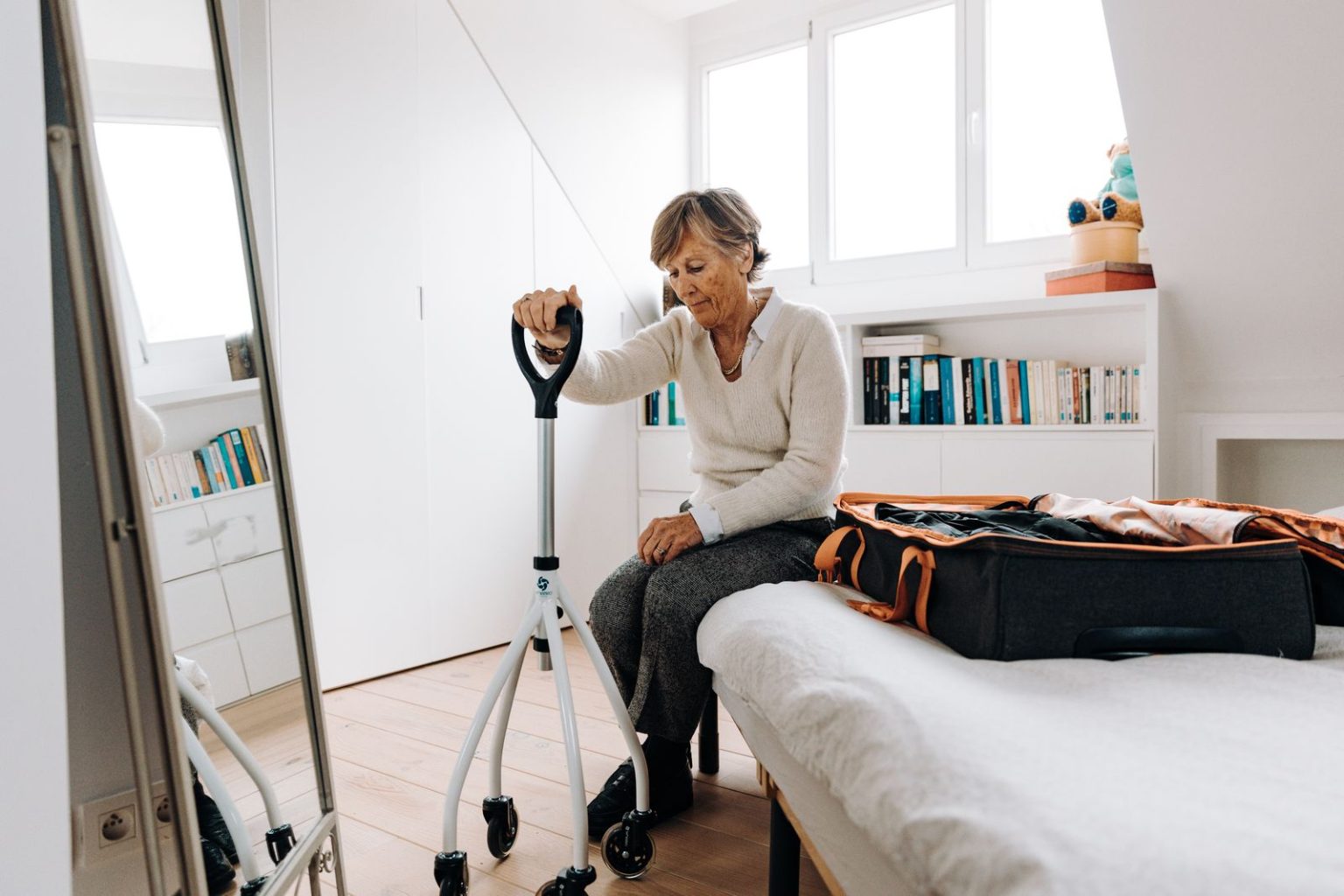
Golden rules for every transfer
- Take your time. Most slips happen when rushing — especially to the bathroom or the phone.
- Pause before you stand. If you feel light-headed when getting up, sit on the edge of the bed or chair for about 30 seconds first. Tell your doctor if dizziness keeps happening.
- Wear non-slip shoes or slippers with a closed back.
- Push, don’t pull. Push up from armrests or the bed — don’t pull yourself up on a walker, towel bar or furniture that could move.
- Lock brakes on wheelchairs and rollators before every transfer.
- Keep your aid within reach, and use it as soon as you stand.
If you’re helping someone
Lifting someone under the arms (sometimes called a “drag lift”) is considered unsafe in professional moving-and-handling guidance — it can injure the person’s shoulders and the helper’s back. If someone can’t stand with only light help, they need a different plan, not more lifting.
Standing up and sitting down
To stand up from a chair
- Shuffle forward to the front edge of the seat.
- Place your feet flat, hip-width apart, slightly behind your knees.
- Put your hands on the armrests.
- Lean forward — “nose over toes.”
- Push through your hands and legs to stand. Pause until you feel steady, then reach for your walker or cane.
To sit down
- Walk all the way up to the chair, then turn so your back is to it.
- Back up until you feel the chair touching the backs of your legs.
- Reach back for one armrest, then the other.
- Bend forward slightly and lower yourself slowly — don’t drop into the seat.
Choose the right chair: firm, with sturdy armrests, and high enough that your knees are about level with your hips. Low, soft sofas and recliners are the hardest to get out of. Furniture risers or a firm cushion can raise a chair that is too low.
Getting in and out of bed
To get out of bed
- Bend your knees and roll onto your side, facing the edge of the bed.
- Let your legs slide over the edge as you push up with your arms to sit.
- Sit on the edge for a moment until you feel steady — no dizziness.
- With feet flat and your aid within reach, stand up as you would from a chair.
To get into bed
- Sit on the edge of the bed, about halfway along.
- Lower yourself onto your side, using your arm for support.
- Lift your legs onto the bed at the same time.
- Roll onto your back.
A bed that is too high or too low makes this harder. When you sit on the edge, your feet should rest flat on the floor with your knees about level with your hips.
Bed rails and bed handles: use with care. They can help with getting in and out of bed, but if they don’t fit the bed and mattress properly, people can become trapped between the rail and the mattress. Health Canada has recalled several bed rail and assist handle products for this reason. Ask an occupational therapist or physiotherapist before buying one — especially if the person is confused or very frail — and check for recalls at recalls-rappels.canada.ca.
Toilet, bath and shower
Research backs this up: older adults who get up to urinate at night have a higher risk of falling (about 20% higher in a review of studies). Steps that help:
- Light the whole path — a night light by the bed, in the hallway and in the bathroom, or motion-sensor lights.
- Sit on the edge of the bed for a moment before standing, especially if you get dizzy.
- Keep the path clear and your walker or cane right beside the bed.
- Ask your doctor about getting up often at night or sudden urges — both can often be treated. A bedside commode or urinal can also help at night.
The toilet
- A raised toilet seat or toilet safety frame makes standing up easier if the toilet is low.
- A properly installed grab bar beside the toilet gives something safe to push or hold.
- Never use the towel bar, toilet paper holder or sink to pull yourself up — they can break or pull out of the wall.
The bath or shower
- Stepping over a high tub edge is one of the riskiest moves at home. A tub transfer bench lets you sit down outside the tub, then swing your legs over one at a time.
- Use a non-slip mat inside and outside the tub or shower.
- A hand-held shower and a shower chair let you wash while seated.
- Keep soap and shampoo within easy reach so you don’t have to bend or twist.
See our home safety checklist for more bathroom tips.
Getting in and out of a car
To get in
- Ask the driver to park away from the curb, on level ground, so you can stand beside the car.
- Turn so your back is to the seat, and back up until you feel it behind your legs.
- Hold something stable — the door frame or seat — not the car door, which can swing.
- Sit down, keeping your head low.
- Lift your legs into the car one at a time (or both together), turning to face forward.
To get out, reverse the steps: swing your legs out first, place your feet on the ground, then stand up. A swivel seat cushion can make turning easier — ask a therapist which one suits you.
Getting dressed safely
- Sit down to dress — especially for pants, socks and shoes.
- Lay out clothes within reach before you start.
- Dress the weaker or more painful side first; undress it last.
- Long-handled aids — a reacher, sock aid or long-handled shoe horn — reduce bending.
- Choose slip-on shoes with a firm back, or shoes with Velcro straps.
Equipment that can help
| Equipment | Helps with |
|---|---|
| Raised toilet seat or toilet frame | Sitting down and standing up from the toilet |
| Grab bars | Support by the toilet, tub and shower |
| Tub transfer bench | Getting in and out of the tub without stepping over the edge |
| Furniture risers or a firm chair with armrests | Standing up from a chair |
| Bed assist handle | Getting in and out of bed — only if properly fitted (see caution above) |
| Reacher, sock aid, long-handled shoe horn | Dressing and picking things up without bending |
| Swivel seat cushion | Turning in and out of a car seat |
An occupational therapist can recommend equipment that fits your body and your home, and show you how to use it.
Practise to stay strong
Practising everyday movements is exercise in itself. Research shows that balance and functional exercises — like standing up from a chair — reduce falls in older adults. Try the sit-to-stand and other exercises in our balance guide.
When to get help
- Standing up, getting out of bed or using the toilet is getting harder
- You need someone’s help with a transfer you used to do alone
- You feel dizzy or unsteady when getting up
- You’ve had a fall or near-fall during a transfer
- The person needs more than light, hands-on help, or their knees buckle when they stand
- The person can’t follow simple instructions during a transfer
- The helper feels strain or pain, or is worried about dropping the person
A physiotherapist or occupational therapist can assess how you move, teach safer techniques, and recommend equipment. Ask your family doctor, or contact Ontario Health atHome at 1-833-515-1234. Family members helping with transfers should read our caregiver guide.
Have a question about daily mobility?
Send it in — common questions are answered here on the site.
Sources
Sherrington C, et al. Exercise for preventing falls in older people living in the community — Cochrane Database of Systematic Reviews, 2019
Understanding orthostatic hypotension — UMass Memorial Health
Adult portable bed rails recalled due to entrapment hazard — Health Canada, 2024
Ontario Health atHome contact — Government of Ontario
Pesonen JS, et al. The impact of nocturia on falls and fractures: a systematic review and meta-analysis — Journal of Urology, 2020
Janssen WG, et al. Determinants of the sit-to-stand movement: a review — Physical Therapy, 2002
Bradley SM, Hernandez CR. Geriatric assistive devices — American Family Physician, 2011
Controversial moving and handling techniques — NHS Fife guidance
This guide is general information, not a personal assessment. If a transfer feels unsafe, stop and ask for help — and have a physiotherapist or occupational therapist show you the safest way for you.